 grenke around the globe
Our ESG vision: Enabler for sustainable SMEs
Our ESG vision at grenke is clearly focused on impact, responsibility, and sustainability: We are accelerating the transition to a green future by offering sustainable financing solutions and enabling our customers to make targeted green investment decisions. We see sustainability not only as an ethical obligation, but also as a strategic growth driver for our customers. After all, sustainable business practices strengthen innovation, competitiveness, and resilience—and open up new market opportunities in a changing economic environment.
At the same time, we see sustainability as a social mission: We promote equal opportunities, diversity, and innovation for employees, business partners, and customers, thereby creating an environment in which entrepreneurial success and social value go hand in hand.
All of this is underpinned by responsible corporate governance based on transparent communication, clear structures, and a sustainable corporate culture. In this way, we not only ensure long-term trust and stability, but also lay the foundation for profitable, sustainable growth in line with environmental and social goals.
TOP KPIs
Defined target
Target value 2030
GHG emissions (Scope 1, 2 and 3)excl. Scope 3 - lease objects
Net zero by 2050
// Scope 1: –50%
// Scope 2: –50%
// Scope 3: –25%
Degree of automation in the core leasing process
Minimise paper-intensive processes and advance digitalisation
Degree of automation of 4 (fully automated)
Share of green economy objects measured against leasing new business
Expansion and promotion of a sustainable SME sector through green investments
10% green economy objects in leasing new business
TOP-KPI
Defined target
Target value 2030
grenke Engagement-Score
Increase employee satisfaction and strengthen diversity
Score of 2.2 (largely satisfied)
Fluctuation rate
Increase employee retention
< 16.3% (sector average for the financial and insurance services sector in 2023)
Average number of contracts per active spe cialist reseller partne
Increase in long-term partnerships
Two additional contracts per specialist reseller partner compared with the 2025 reference year
TOP-KPIs
Defined target
Target value 2030
Overall Strategy Awareness (Score)
Strengthen identification with the corporate strategy
Score of 2.5 (high level of awareness)
Integrate ESG aspects into corporate management
Share of top management positions with a sustainability component in variable remuneration
Sustainability targets linked to climate and strategic objectives
Completion rate of Internal Audit reviews
Strengthen internal controls and compliant behaviour
Completion of 85% by year-end, 15% in Q1 of the following year
A summary of our key ESG indicators can be found here
Climate protection as a strategic priority
With our sustainability strategy and a clearly defined climate action plan, we are pursuing the goal of reducing our greenhouse gas emissions to net zero by 2050. Through targeted measures to reduce emissions in Scopes 1, 2, and 3, we are making an active contribution to climate protection. At the same time, we are strengthening the resilience of our business model through climate change adaptation measures and creating long-term value for our stakeholders – including small and medium-sized enterprises, business partners, employees, and investors.
Our climate strategy is firmly anchored in our business strategy and supports the global goal of limiting global warming to 1.5 degrees Celsius above pre-industrial levels, in line with the Paris Climate Agreement.
Climate action plan and target system
Our climate action plan (transition plan) forms the central framework for implementing our climate targets and meets the requirements of the ESRS. The definition of targets is based on scientifically sound methods and the recommendations of the Science Based Targets Initiative (SBTi). We plan the external validation of our targets by the SBTi in the future.
We have formulated reduction targets with a medium-term horizon until 2030 and long-term targets until 2050. These are based on a cross-sector reduction pathway. The targets cover all relevant activities in Scopes 1, 2, and 3 in accordance with the Greenhouse Gas Protocol, however not yet including the Scope 3 emissions of our leasing portfolio. These were recorded for the first time in 2025, and corresponding reduction targets are currently being developed.
Since the defined base year, we have already made significant progress in reducing our greenhouse gas emissions. Overall, we have already achieved 84% of our original reduction targets for 2030 across all three scopes (excluding the leasing portfolio), putting us well ahead of the original schedule.
A further development and validation of the climate action plan is planned for 2026; the plan is available for download on our website.
Decarbonization levers and measures
Our reduction measures focus on those areas that account for the largest share of our direct greenhouse gas emissions:
Scope 1 – Company fleet: Emissions from our company fleet represent the main lever in Scope 1. By consistently switching to electric mobility, we aim to reduce company fleet emissions by 60 percent by 2030.
Scope 2 – Electricity consumption: Electricity consumption from non-renewable sources is the main source of emissions in Scope 2. At locations where we are responsible for purchasing electricity, we rely on electricity from renewable or emission-free sources. This should result in a 90 percent reduction in electricity emissions by 2030.
Scope 3 – Travel, commuting, purchasing, and logistics:
We have implemented initial measures to reduce Scope 3 emissions:
- Our travel policy promotes climate-friendly travel and aims to reduce emissions by 27 percent by 2030.
- To reduce emissions from commuting, we are offering incentives for the use of public transportation, carpooling, and employee bicycle leasing. This should save 8 percent of commuting-related emissions by 2030.
- Emissions from purchased goods and services are to be reduced by 27 percent by 2030. This is supported by our digitalization initiative and the newly introduced e-procurement tool Coupa, which enables improved data quality and more efficient processes.
- We want to reduce emissions from downstream transport by 25 percent by 2030, among other things through more climate-friendly logistics solutions and process optimizations in collaboration with our asset brokers.
Further measures will be developed gradually and reported on in the coming years.

Climate related risks
We have identified locked-in greenhouse gas emissions as the most relevant risk. We are adapting our own buildings to new energy requirements as far as possible and developing them further in line with our New Work concept. As tenants, we have only limited influence on the structural fabric of larger building complexes, but we can usually choose our own electricity tariff and specifically consider buildings with better energy performance when deciding on locations.
Our leasing portfolio consists mainly of mobile assets with terms of less than ten years and is broadly diversified. The strategic expansion of green economy properties and the increasing share of renewable energies in the global electricity mix are expected to contribute to a further reduction in emission-related risks. Accordingly, we assess the risk of locked-in greenhouse gas emissions to our company as low due to our business model.
Governance, management, and economic efficiency
The Climate Action Plan is an integral part of our climate governance and is firmly anchored in our sustainability strategy. This is closely linked to our business strategy. The ESG team coordinates the operational implementation of the Climate Action Plan together with individual departments and reports regularly to the Management Board and the Sustainability Committee.
The Management Board decides on group-wide climate protection concepts and has approved the Climate Action Plan. Investment and operating costs for emission reduction measures are taken into account in overall cost planning and regularly coordinated with the Management Board and Supervisory Board. Due to our business model, we have not currently identified any significant financial implications from the implementation of our reduction targets.
Share of Green Economy Objects
eSignature
eContract quota

Scope 3
Scope 3 covers all indirect greenhouse gas emissions along our upstream and downstream value chain that arise outside our direct operational control. For our business model, Scope 3 emissions represent the majority of our corporate carbon footprint.
The majority of these emissions at grenke are attributable to leased assets. We also take into account other emission categories that we have identified as significant and influenceable.
These include:
- purchased goods and services,
- business travel,
- employee commuting,
- downstream transport of leased assets after the end of the contract as part of our asset broker processes, and
- waste generated.
These categories are within our company's sphere of influence and are systematically accounted for.
Methodological development for leased objects
Due to the high diversity of our portfolio and the large number of object types, markets, and customers, determining the emissions from the manufacture and use of our leased objects has long been a methodological challenge. Existing market solutions did not offer sufficient data depth or comparability.
In 2025, we developed our own methodology to reliably include the emissions from our leased properties in our corporate carbon footprint for the first time. The development of the methodology was preceded by consultation with the Federal Association of German Leasing Companies and market benchmarking, in which common recording approaches and available data pools were analyzed.
Life cycle accounting
The largest emissions from a leased property typically occur during the manufacturing phase and the usage phase.
We account for these emissions accordingly:
- manufacturing emissions in Scope 3 Category 2,
- usage emissions in Scope 3 Category 13.
Both categories were identified as material to our business model. The calculation is based on the asset portfolio and takes into account both additions and disposals during the year. Due to the large number of individual leased assets, asset groups were formed based on the leasing portfolio presented in the report.
Results and classification
Thanks to the new methodology, reliable estimates of the emissions of our leased objects were determined for the first time in 2025 and fully integrated into our corporate carbon footprint. We have no direct influence on the manufacturing processes of the leased objects themselves, as these are the responsibility of the respective manufacturers and we act solely as an intermediary. The Scope 3 survey, which has been continuously developed since 2022, now covers all locations and areas used.
Scope 3 emissions for the 2025 fiscal year amounted to 2,610,756 tons of CO2. Due to the first-time recording of Scope 3 emissions including the leasing portfolio, no comparative figures for the previous year are available at this time. Our Scope 3 emissions excluding the leasing portfolio amounted to 3,490 t CO2 in 2025 (2024: 4,183 t CO2).
Sustainable refinancing as a strategic ESG driver
Sustainability aspects are an integral part of our capital market strategy. With targeted ESG financial instruments such as green and social sustainable bonds, we specifically support projects with a measurable positive impact on the environment and society.
Our Green Bond Framework and our Sustainable Bond Framework are based on the ICMA Green, Social, and Sustainability Bond Principles and the UN Sustainable Development Goals (SDGs). Both frameworks have been reviewed and confirmed by the independent ESG rating agency Sustainalytics.
Our green bond
In September 2023, grenke issued its first green benchmark bond worth EUR 500 million, with the proceeds being specifically allocated to projects with a measurable positive impact on the climate and environment. 100% of the funds have been invested in categorized “green economy objects” – from clean mobility to energy and resource efficiency as of September 29th, 2025. The link to clearly defined use-of-proceeds criteria ensures transparent allocation of funds in accordance with international standards.
Our green bond projects actively contribute to the achievement of several Sustainable Development Goals. The focus is on sustainable mobility, renewable energy, water and waste management, and energy efficiency, among other areas. Based on the allocated volume, 70.1 percent is attributable to clean mobility, which highlights the contribution to decarbonization and support for sustainable SME investments.
Our ESG financing processes are subject to clear governance structures and are regularly reviewed—both internally by our audit department and by external analysts. These review mechanisms ensure the correct selection of projects and use of funds, thereby creating a high degree of transparency and credibility for investors and other stakeholders.
Our social bond
On September 27, 2024, we placed our first social bond with a volume of €500 million. 100% of the funds have been allocated to finance lease contracts of SME in countries with above average unemployment as of September, 27, 2025. This social bond is based on our sustainable bond framework, which combines environmental and social impact in a holistic financing approach. At the end of fiscal year 2025, a total of EUR 1 billion from our green and social bond had been fully allocated.
Our Sustainable Bond Framework is based on the ICMA Green Bond Principles, the Social Bond Principles, and the Sustainability Bond Guidelines, and has been independently reviewed and impact-oriented assessed by Sustainalytics. We are thus setting standards for sustainable refinancing that not only promotes environmental transformation but also supports social development.
The use and allocation of funds are subject to a fixed governance process: our Sustainable Bond Committee manages the ongoing review of projects, and the allocation of funds is systematically documented and monitored. This structured approach ensures that sustainable bonds are used not only instrumentally but also in an impact-oriented manner.
Sustainability Bond
Discover our coverage of sustainable refinancing – with clearly defined criteria, verified use of funds, and measurable added value for the environment and society. Download our Sustainable Bond Report and the associated framework to learn more about our sustainable financial instruments.
Financing green economy solutions
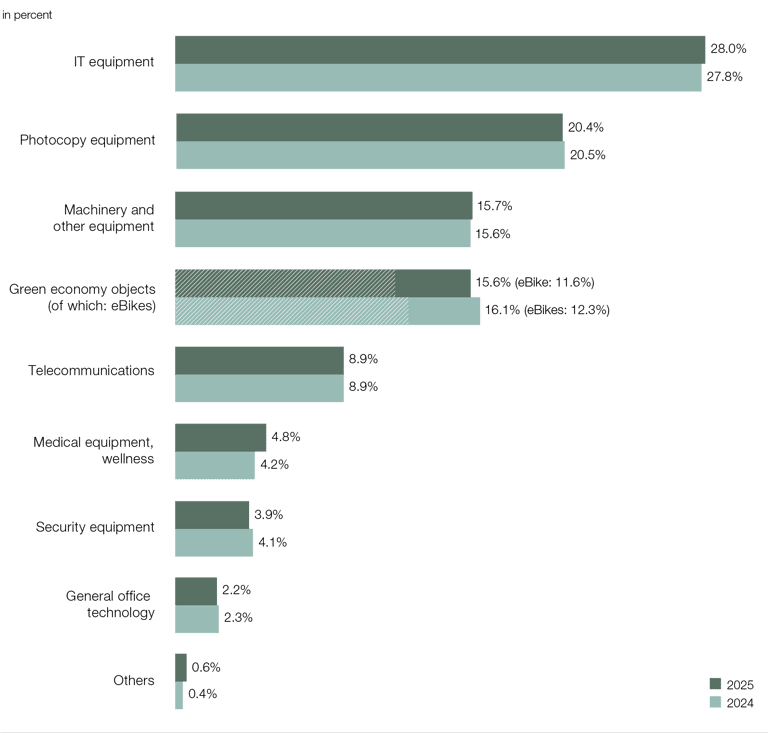
By providing targeted financing for green economy objects, we are contributing to the sustainable transformation of our customers' business activities while also supporting the structural shift in the economy towards greater climate protection and resource efficiency.
By green economy objects, we mean capital goods that contribute to the generation, storage, or efficient use of renewable energies, sustainable mobility, or responsible resource management.
These include, among other things:
- Photovoltaic systems and energy storage devices,
- wall boxes and charging infrastructure and
- sustainable mobility solutions such as e-bikes.
grenke is continuously developing its market approach for green economy objects. A key focus is on addressing and acquiring new specialist retail partners and customers in order to systematically expand the range of sustainable financing solutions.
In 2026, we will provide targeted support for our sales activities through market analyses of current developments in green economy objects and in-depth specialist information. In addition, we plan to introduce a new internal newsletter format for German sales to provide regular updates on knowledge, market trends, and sales initiatives.
Beyond the environmental sector, we also contribute to the social aspects of ESG. For example, we enable medical practices and medical facilities to finance medical equipment, thereby supporting healthcare and medical infrastructure.
The share of green economy properties in our total portfolio rose further in 2025. It stood at 8.1 percent, up from 7.8 percent in the previous year. In Germany, the share is significantly higher at 17.1 percent due to the strong eBike business.
grenke Sustainability Index (GSI)
The grenke Sustainability Index (GSI) is a key tool for implementing our guidelines. It makes sustainability in the leasing business transparent, measurable, and usable in everyday life. We use the GSI to evaluate every lease agreement from the initial inquiry onwards, taking into account the customer, the industry, the agreement, and the asset, and summarizing environmental, social, and governance criteria in an easy-to-understand score.
The GSI is specifically aimed at small and medium-sized enterprises. It provides relevant information and evaluation criteria at the point of sale and supports SMEs in consciously choosing more sustainable leasing options.
At the same time, the GSI raises awareness of sustainable business practices and motivates companies to gradually make their leasing decisions more environmentally conscious and responsible – without adding complexity to their day-to-day business.
Promoting sustainable decisions among SMEs
The GSI is specifically aimed at small and medium-sized enterprises. It provides relevant information and evaluation criteria at the point of sale and supports SMEs in consciously choosing more sustainable leasing options.
At the same time, the GSI raises awareness of sustainable business practices and motivates companies to gradually make their leasing decisions more environmentally conscious and responsible – without adding complexity to their day-to-day business.
Transparency, comparability, and concrete recommendations
The GSI makes sustainability comparable and comprehensible. It provides concrete information on more sustainable alternatives, for example through:
- digital contract processes,
- electronic invoices,
- specific object or product categories.
Sustainable growth and strategic importance
Sustainability is an integral part of grenke's long-term corporate strategy. Sustainable business models contribute to the stability, resilience, and long-term growth of the company.
With the targeted use of the GSI, grenke is strengthening its market position as a financing partner for small and medium-sized enterprises and underlining its claim to be a leading provider of sustainable financing solutions. Together with customers and partners, we are paving the way to a sustainable future – one that is both economically successful and responsible.
Circular economy as part of our business model
The principles of sustainable use of ressources and circular economy are firmly anchored at the core of our leasing business. We finance durable new goods that are reused, resold, or recycled at the end of the lease term. This extends the actual life of the leased assets significantly beyond the original contract period.
Our current materiality analysis confirms that recyclable solutions are becoming increasingly important and at the same time represent a relevant market potential for grenke. Through targeted processes throughout the entire life cycle of leased assets, we contribute to conserving resources, reducing waste, and strengthening sustainable business models.
Regenerative concepts of the circular economy have been part of our business model from the very beginning. When selecting leased assets, we ensure that they comply with current market and technology standards in order to guarantee the longest possible useful life.
At the end of the contract, we transfer suitable leased assets into a second product life cycle in a targeted manner—for example, through resale or reconditioning. We see this as a logical further development of our business model in order to conserve resources in the long term and generate additional added value.
A key lever in this process is the use of our own asset brokers in Germany, France, and Italy. They enable us to systematically recondition returned leased assets and put them back on the market instead of disposing of them prematurely. Thus, less than 1% of all returned lease objects are disposed of.
Impacts, opportunities, and risks (IRO analysis)
Extending the product life cycle through reuse has a significant positive impact on the environment. At the same time, we are aware that inadequate take-back, recycling, or disposal processes at the end of the life cycle can lead to environmental pollution.
In particular, we identify the risk of electronic waste as a potentially negative impact. We counter this with professional recycling and disposal processes that are strictly implemented in our core markets in accordance with local legal requirements.
Guidelines and organizational anchoring
Our approaches to promoting the circular economy are part of our sustainability strategy and are anchored in binding regulations.
These include in particular:
- our guidelines for responsible financial products,
- and our environmental policy.
In our guidelines for responsible financial products, we transparently describe our management approach for lease returns and ensure clear communication with our SME customers – even beyond the actual lease term.
Among other things, the environmental guideline defines the requirement to reuse usable materials such as cardboard boxes, plastic film, and pallets. Materials that can no longer be used are collected and recycled properly.

Measures to promote the circular economy
The majority of leased items are resold to specialist retail partners at the end of the contract. For remaining items, we operate our own recycling platforms in our core markets, through which leased returns are sold to third-party customers after technical inspection.
Our approach covers four key principles of the circular economy in particular:
- Reuse – reuse of products,
- Repair – repair instead of replacement,
- Refurbish – reconditioning and modernization,
- Remanufacture – use of components to manufacture new products.
Since 2024, we have been systematically driving forward the expansion of this area, among other things by introducing central responsibility for the circular economy and by further developing our asset broker structures. In addition, through our stake in Miete24, we are gaining valuable experience in the direct sale of returned lease objects.
Grenke operates its own asset brokers in its largest markets, Germany, France, and Italy. In fiscal year 2025, we further professionalized our remarketing approach and integrated it more closely into our customer communications. Our German asset broker's online shop was completely redesigned to enable leased equipment returns to be given a second life more efficiently.
In addition, our asset brokers offer additional services, including:
- Recycling, including technical inspection and certified data deletion
- Pickup of leased items as a service
- Certified data deletion as a standalone offering
We are also optimizing our logistics processes. In Germany, we use climate-friendly shipping solutions such as DHL GoGreen and rely on reusable pallets, especially Euro pallets. This allows us to reduce emissions, avoid waste, and extend the useful life of existing resources.
Sustainable Corporate Governance
Sustainable corporate governance is a central component of grenke's ESG strategy and is closely linked to our corporate responsibility. It ensures that environmental, social, and governance aspects are systematically integrated into all business processes and that decisions are made responsibly for the long term.
The focus is on a transparent, ethically sound, and trusting corporate culture based on clearly defined values and the highest standards. This includes a functioning compliance management system that covers issues such as information security, money laundering prevention, anti-discrimination, and human rights, and is anchored in the Code of Conduct.
Sustainable corporate governance at grenke is supported by an ESG governance model: The operational management of the sustainability strategy is the responsibility of the ESG department, which controls the strategic development, coordination, and implementation of relevant ESG activities across the group. A sustainability committee with representatives from central corporate divisions ensures the exchange of expertise, the integration of sustainability into key processes, and the coordination of risks and opportunities along the value chain.
Key management tools, guidelines, and progress are published regularly in non-financial reporting and in the annual report. In addition, detailed ESG documents such as the sustainability strategy, climate action plan, code of conduct, and other guidelines are available in the download area.
Reporting Standards
In fiscal year 2025, grenke consistently advanced its sustainability reporting, basing its content on the requirements of the Corporate Sustainability Reporting Directive (CSRD) and the European Sustainability Reporting Standards (ESRS). Although the CSRD had not yet been transposed into German law at the time of reporting, grenke voluntarily prepared its non-financial reporting in accordance with the ESRS and in line with the requirements of the German Commercial Code (HGB). This underlines our commitment to transparent, forward-looking and European-oriented ESG reporting. This year also saw the first TCFD reporting.
To further strengthen transparency and credibility, non-financial reporting was also voluntarily audited externally in 2025. The Annual General Meeting appointed BDO AG Wirtschaftsprüfungsgesellschaft as the auditor for this purpose in order to obtain limited audit assurance.
Principles
In its non-financial reporting, grenke provides transparent information on the development status of its sustainability strategy as well as on related management approaches, governance structures, key measures, and progress achieved.
Sustainability-related impacts, risks, and opportunities are considered over short-, medium-, and long-term time horizons. The reporting is based on the principles of the European Sustainability Reporting Standards (ESRS).
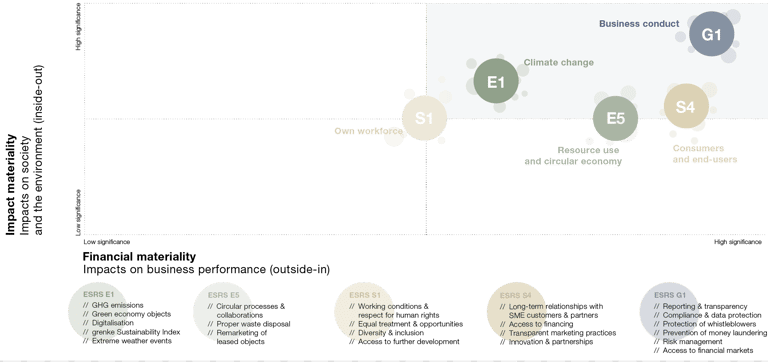
The updated double materiality analysis forms the basis for the selection of material ESG topics. For the reporting year, the focus was on five topics in particular: climate protection, circular economy, company workforce, consumers and end users, and corporate governance. These focal points reflect grenke's material sustainability impacts along the value chain.
The underlying data relates to the Group and is based on primary data wherever possible. When determining greenhouse gas emissions and consumption, existing data gaps were closed using sound methodology to ensure consistent and comprehensible presentation.
Raising awareness of compliance and integrity
At grenke, compliance training and awareness measures are essential components of our corporate and governance culture. They ensure that all employees are familiar with the binding rules, values, and ethical standards and implement them in their daily work.
Our compliance department develops and supports group-wide training and information programs on relevant topics, including:
Code of conduct and ethical standards: Employees are trained in what our Code of Conduct means and how it is applied in their daily work.
Legal and regulatory requirements: Awareness-raising measures address key legal requirements, e.g., regarding conflicts of interest, anti-corruption, and money laundering prevention.
Monitoring and controls: In addition to formal training, the compliance organization helps to deepen awareness of compliance risks in everyday work through information and practical examples.
Data protection awareness: Employees are also made aware of the secure and legally compliant handling of data and data protection requirements.
Training courses on anti-bribery and corruption
Mandatory trainings are held throughout the Group to prevent corruption, bribery, and other compliance violations. The training activities address both high-risk positions and managers and other employee groups.
A total of 2,427 people were defined as requiring training. Training coverage was 94% for high-risk positions, 91% for managers, and 89% for other employees.
The trainings are mainly conducted online, across the Group, and in multiple languages. The central formats are the mandatory money laundering training and the mandatory compliance training.
The mandatory money laundering training covers topics such as bribery, corruption, money laundering, terrorist financing, fraud, and prevention and risk management measures. The mandatory compliance training addresses topics such as conflicts of interest, gifts and invitations, ethics and compliance, whistleblowing, handling confidential information, and personal and financial interests.
Mandatory trainings are conducted annually, with the mandatory compliance training alternating with a refresher course. This structured training landscape ensures that compliance risks are systematically addressed and that compliant behavior is sustainably anchored in everyday work.
House of Benefits
grenke's long-term success is inextricably linked to the well-being, satisfaction, and development of its employees. As an employer, we take responsibility for creating an attractive, inclusive, and future-oriented working environment and actively shape it.
This is based on our comprehensive range of employee benefits – the so-called “House of Benefits.” It includes a transparent and performance-based salary model as well as additional benefits in the areas of flexibility, family, health, and personal development. The benefits take into account different stages of life and provide guidance, security, and individual support. The measures relate to our own business operations and are geared toward the short, medium, and long term.
Well-being in the workplace
The HR and Work Environment departments share responsibility for creating a safe, healthy, and supportive working environment. While Work Environment is responsible for safety and health in the workplace, HR manages measures to promote the mental and physical health of employees. The effectiveness of these measures is reviewed regularly, including as part of the annual employee satisfaction survey and when updating the impact, risk, and opportunity assessment in the course of the double materiality analysis.
Relevant data is systematically collected and analyzed to identify and evaluate negative impacts, such as workplace accidents, sick leave, or complaints. The aim is to identify causes and patterns and use them to derive concrete measures for risk reduction or elimination. In this way, we ensure that risks are addressed at an early stage and working conditions are continuously improved.

Mental health
Mental Health
The mental health of our employees is an important part of our holistic approach to health. We offer targeted programs to promote a conscious and balanced approach to information, emotions, and stress factors in everyday working life. These include mental health awareness training and information events on topics such as resilience and burnout.
grenke offers its employees 16 mental health advisors who are qualified to answer questions about mental health.
Our health offerings are complemented by a health day at headquarters, online seminars, and additional services such as occupational disability insurance. In this way, we create a supportive environment that sustainably promotes health, prevention, and well-being.
Development
Continuing education strengthens innovative capacity, expertise, and job satisfaction. That is why we offer a wide range of opportunities for ongoing professional development.
Our learning management system, “talent lab,” provides all employees with access to more than 80 training courses in various subject areas, available on demand or live in German and English. We also specifically promote young talent and continuously develop our training and study programs.
Flexibility
Flexible working models are a central component of our modern work culture. In 2025, our employees worked from home an average of three days per week. As a rule, at least one day per week is designated for remote work, and depending on the job and in consultation with the manager, up to four days are possible.
Digital training courses support remote working. Modern locations promote exchange and creativity. In addition, we offer workations, sabbaticals, and a flexitime model with transparent time recording for self-determined work arrangements.
Family
We support our employees in achieving a good work-life balance. In special life situations, a temporary reduction in working hours with full pay is possible.
Parents can also reduce their working hours on a temporary basis after the birth of a child with full pay compensation. In addition, we provide financial support for childcare and care of relatives, allow time off for sick children, and keep employees connected to the company during parental leave through our “Parents Connect” exchange format.
Employee satisfaction
The annual employee survey forms a key basis for assessing our attractiveness as an employer. The group-wide survey determines the grenke Engagement Score (GES), which is defined for measuring employee satisfaction.
The GES measures employee satisfaction in terms of engagement, identification, and loyalty, as well as overall satisfaction with the company. The assessment is based on a scale from 1 (high satisfaction) to 7 (low satisfaction). The aim is to maintain a consistently high level of employee satisfaction.
In the current fiscal year, we reached 2.2, which is largely in line with the previous year's level.
We derive improvement measures from our employees' perspectives.
To track the achievement of targets, the relevant key figures are collected once a year for all grenke employees, supplemented with comparative values, and systematically evaluated in terms of their development. In addition to the quantitative survey, annual employee appraisals serve as a supplementary tool. They offer employees the opportunity to discuss feedback, concerns, and issues directly with their manager.
Sustainable development thrives on dialogue, transparency, and the active involvement of relevant stakeholders. At grenke, we see sustainable communication as a strategic tool for communicating our ESG ambitions in a transparent manner, promoting internal exchange, and providing impetus for continuous development. Through clear, consistent, and target group-oriented communication, we provide guidance, raise awareness of sustainability in everyday work, and make progress and challenges transparent. In doing so, we combine internal exchange formats with digital communication solutions to effectively anchor sustainability both within the company and externally.
In order to further strengthen dialogue with internal stakeholders and promote innovative approaches at an international level, grenke launched the Sustainfluencer format in 2025. The aim of this new dialogue format is to actively advance and continuously develop the sustainability strategy. Employees from different countries and functions contribute to a global internal ESG network. The Sustainfluencer network currently comprises more than 40 colleagues worldwide who act as multipliers for sustainability and bring new impetus to the organization.
Three virtual workshops were held in 2025.
Thematic focal points included:
- ESG in grenke sales,
- ESG storytelling,
- employee well-being, and
- mental health.
Digital Annual Report
Sustainability is part of our corporate strategy and an integral part of our responsibility towards our customers, business partners, and society. An open, transparent, and comprehensible communication about our goals, measures, and results across the ESG dimensions of climate & environment, social contribution, and responsibility & trust are important to us. This enables us to create a reliable basis for dialogue on sustainable development and support informed decision-making.
For detailed information on the implementation of our sustainability strategy, results, key figures, and further reports, we recommend taking a look at our annual report. There you will find our non-financial group statement as well as in-depth ESG explanations and background information.
ESG Ratings
Since 2022, grenke has participated in ESG rating processes conducted by the leading ESG rating agencies MSCI, ISS ESG, S&P, and Sustainalytics, as well as the CDP initiative.
Compared to the previous year, there has been an overall improvement in ESG performance from 2024 to 2025. While some ratings remained stable, significant progress was made with individual rating providers in particular.
The upward trend in various ESG ratings reflects our ongoing commitment and the ongoing optimization of our processes in dealing with customers and specialist retail partners. We will continue to pursue the goal of further improving our ESG ratings in the coming fiscal year.
Rating results at a glance
-
The AA rating was maintained in the MSCI ESG rating. This means that grenke continues to be one of the above-average companies in the industry comparison.
-
In the ESG risk rating by Sustainalytics, the score improved slightly from 19.95 to 19.88, placing it in the low ESG risk range.
-
The ISS ESG rating remained unchanged at C-, putting it just below the threshold for Prime Standard.
-
The S&P Global ESG score rose significantly from 32 to 39 points, placing grenke in the top quarter of the benchmark comparison.
-
To ensure transparent reporting on CO₂ emissions and climate-induced opportunities and risks, we again submitted the Carbon Disclosure Project questionnaire for the 2025 financial year. The result improved significantly to a score of B (previous year: D).


